|
From the National Contest Journal http://www.arrl.org/ncj/
Volume 24, issue 6 (Nov/Dec 96)
Four-Square Antenna Experiences
By Jack Schuster, W1WEF ( w1wef@snet.net) and Tom Frenaye, K1KI (frenaye@pcnet.com)
Antenna #1, Antenna #1, Antenna #2, Antenna #2, #1, #2, #1, #2... VK6ACY from
W1WEF." That was September ‘95, when the new 4-square on 80 meters was being
compared to a dipole. Looking back in the log, on September 14 the 4-square was 3 S-units
louder than the 80-ft-high dipole. Front to back was 20 to 24 dB. It was really neat to be
able to steer an antenna on 75 meters!
Although many of the big gun contest stations with 4-squares have quite elaborate
systems using towers on insulated bases or tapered aluminum full quarter wave verticals,
we have taken a simpler approach, suspending verticals from ropes strung from the top of a
single tower. Part of the impetus to try this came from Willy Umanets, UA9BA, although
Willy probably doesn’t know he did it!
On December 20, 1994, Willy wrote the UN2L 80-meter story on the Internet Contest
Reflector. Excerpting from what he said... "W1KM was the first US signal worked, S5
to S6. I heard W3LPL and N2RM, but they couldn’t hear me. Later, after 2200Z the band
started peaking, and I worked K4VX and N2RM easily. Right then, KC1SJ [now W1UK] called,
boy what a signal! Who is this guy? K1AR called shortly after, at least two S-units weaker
than KC1SJ. K1TR followed AR, about the same strength as AR. K1IU about one S-unit weaker
than this KC1SJ. KY1H a little weaker than K1IU, then K1K? called. Was it K1KP or K1KI? No
QSO."
After reading about this "KC1SJ Guy," and knowing Jim had no big antenna
farm, we had to find out what he was using at his new QTH. It turned out to be a
four-square supported by trees, with elevated radials! On each vertical element, he had 8
radials 15 feet off the ground. Each vertical element was a "cage" of three or
four wires spaced about a foot in diameter, mainly in the interest of improved bandwidth.
What is a Four Square?
Four verticals located in the corners of a square that is one-quarter wavelength on a
side is referred to as a "four square" array. With proper phasing, directivity
can be selected along the square’s diagonals (see Fig 1). The square is
therefore oriented so that one diagonal points toward Europe (here in New England
that’s 45 degrees). To obtain the proper phase relationships we use a Comtek Systems
(KF4HK) hybrid phasing box. A remote switch box in the shack allows selection of four
directions: NE, SE, SW, NW.
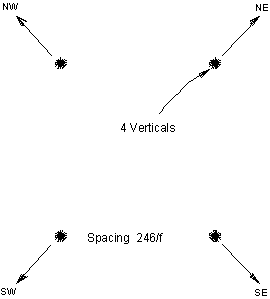
Fig 1—4-square array.
In our configuration, each vertical has four elevated radials (see Fig. 2), each
a quarter wavelength long. Each vertical is connected to the phasing box through
quarter-wave lines of 70-ohm RG-11. The phasing box is mounted on a tower leg, at the base
of the tower, and a dummy load is connected to the phasing box. The dummy load at W1WEF is
actually in the shack, with 50-ohm coax going from the phasing box to the dummy load. This
allows a watt meter in the shack to monitor power that is "dumped" into the
dummy load.
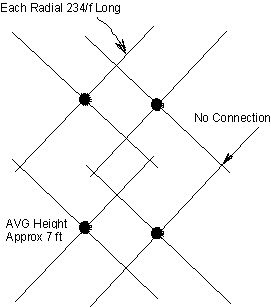
Fig 2—Elevated radials (top view).
W1WEF Build I
In order to have sufficient height for a full quarter wave vertical on 80 meters, ropes
were strung from the top of the tower out over treetops. To get the ropes in the right
direction, a fishing line was shot from the top of the tower with a slingshot that has a
closed-face reel mounted on it (from a KC1SJ QST article!). The fishing line was
used to pull up nylon twine, and the twine was used to pull up the rope. The measured
length of rope from the tower to the vertical was polyester, with the remainder of the
rope nylon. Polyester rope is strong, but doesn’t stretch like nylon when wet. During
the past winter, Connecticut had some of the worst winds ever, which resulted in an
opportunity to do it all again!
W1WEF Build II
This time improvements were made to avoid more opportunities for a rebuild! It was
decided that ropes over treetops, especially when the other end is on a fixed object like
a tower, are not good. Three of the four ropes broke from abrasion over branches. Build II
included raising the tower another ten feet (also rebuilding and reinforcing the 2-element
40 per N4KG in NCJ), and this time running ropes from the top of the tower to tree
trunks close to the ground.
With the 108-ft tower, it is not possible to drop full-length verticals from ropes
(unless perhaps the ropes went out much further than I could go in my heavily wooded lot),
so I decided to follow the lead from GM3POI and use top loading on shorter verticals.
Clive uses 45-ft vertical 12-gauge wires, dropped from ropes off his 70-ft tower, with
inverted top hats of two 16-ft lengths of wire. One follows down the direction of the
rope, the other is tied off on his tower with a rope going to the twenty foot mark.
Build II was slightly different than Clive’s. Instead of the Inverted V, a sloping
T top hat was used, with the top in line with the rope. Dimensions are shown in Figure
3.
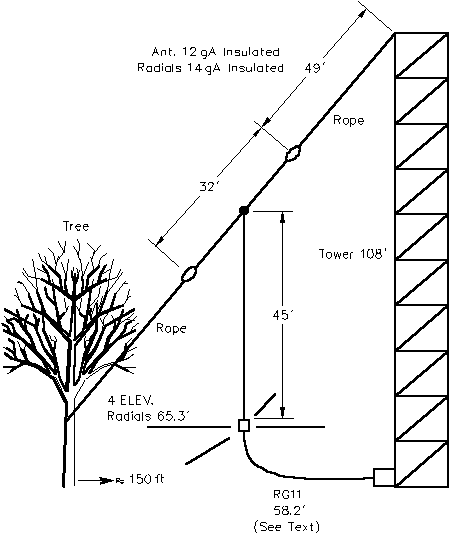
Fig 3—W1WEF "Build II".
K1KI Build I
An inverted V at 90 feet used to be a competitive 80-meter antenna in the northeast.
But as sunspots declined the low bands became much more important to the final contest
totals, so several attempts were made to build a better mousetrap. My 5-element inverted V
array never worked right, and an 80-meter rotatable dipole had mechanical problems. My
160-meter ground plane with eight raised radials seemed to work so well that an 80-meter
design with four of them (4-square) was the next project. It just happened that my 130-ft
tower with four 20-meter beams was in the right place at the right time, and it still had
ropes from the failed 5-L inverted V array.
Four 70-ft wires were suspended from four ropes (K3KNH sells some nice 1/8 inch woven
rope) attached at the 130-ft level and tied to trees about 150 to 200 feet from the tower
base. A 10-ft pressure-treated 4x4 makes a great base for each vertical and provides a
place to attach radials, making the feedpoint about 7 feet off the ground. Otherwise the
design is similar to that used by W1WEF, using the same Comtek phasing box (they cost
about $325, and DX Engineering sells a similar model). The second project will show you
how a 4-square for 80 meters can be built around a 70- or 80-ft tower.
K1KI Build II
Once the 80-meter 4-square was in place, and some elusive problems with poorly soldered
coax connectors tracked down, it seemed worthwhile to think about the same thing on 160
meters. The existing 160-meter ground plane antenna consisted of a 135-ft wire attached at
the 118-ft level of the tower that has two Cushcraft 2-element 40-meter beams. It slopes
out from the tower to a point about 60 feet from the tower base, and about 10 feet lower
than the base (down the hill). It’s fed about 8 feet off the ground and has eight
raised radials.
This was a "killer" antenna already, so why tinker with success? A 4-square
offered the possibility of 3-5 dB for- ward gain, plus 20-25 dB front-to-back rejection. A
120-ft tower obviously doesn’t allow for using ropes to suspend full-size
quarter-wavelength verticals, so the "sloping T" method described by W1WEF was
used. The three new verticals were made with a 90-ft vertical component, and a 45-ft
sloping T, with each end attached to a rope. These three new antennas aren’t exactly
vertical. Though the bases are in a 1/4 wavelength square (almost), the vertical wires
slope inward toward the tower, so the T junction is only about 45 feet from the tower.
That way the ropes holding up the verticals don’t have to be attached too far away
(and yes, the 80-ft trees nearby help also).
The result? It does have 20-25 dB front-to-back rejection, the antenna switches
directions easily, and it is better than the single ground plane.
Practical Considerations
1. It is suggested that one vertical be put up and pruned for the desired frequency
first, and then the other three made identical. However, the "desired frequency"
is not what you think it is! Say you want the system optimized for 3510 kHz. Due to mutual
coupling, the resonant frequency of the verticals in the array shifts upward. Comtek
recommends tuning the individual verticals 5% lower than the desired frequency. Following
their recommendation, that means 3335 kHz!
2. Make the other three verticals as identical as possible to the first. This is not as
easily done as said, especially when on uneven terrain.
3. Use foam RG-11 coax or the lines will not reach the phasing box. Cut to 246 x
Velocity Factor divided by Frequency. In this case the frequency is the truly desired
frequency of 3510 kHz. The W1WEF CATV RG-11 had a velocity factor of 0.83 as measured with
an Autek RF1 antenna analyzer. (See the Mar/Apr ‘96 NCJ article, "Installing
PL259s on CATV Coax.")
4. Space the verticals a quarter wavelength apart (246/f). If the system is balanced,
with all four verticals close to identical, the dumped power (power not transferred to the
antennas) will be under 5%.
5. Radials may cross each other in a pattern as shown in Figure 2. The radials
are not connected together where they cross. Length is 234/f, minus about 2% when
insulated wire is used. Fourteen gauge insulated stranded wire is fine for radials.
6. The termination scheme used at W1WEF at the bottom of each vertical is shown in Figure
4.
7. Consensus of 4-Square users surveyed on the packet cluster is that if the array is
optimized for CW, it will not play on phone, and vice versa. It is necessary to change the
length of the radiator. Some even change the length of the phasing lines when going from
one mode to the other. It should be noted that looking at SWR into the hybrid is
meaningless, as it will always look fairly good. The key to efficient operation is the
dumped power, which should be low.
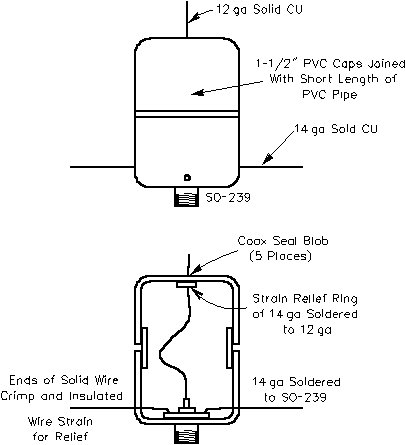
Fig 4—Bottom termination.
Results!
For W1WEF, after seeing the awesome 80-meter antennas at W0UN, N4AR, K3ZO, W3LPL, and
K1EA to name a few, this simpler approach gives a competitive edge never dreamed of. It is
possible to put a four square up without great expense. It just takes a lot of wire, a lot
of work, and a lot of room.
In the 1996 ARRL DX Contest, the 160-meter QSO/country total for the K1KI multi-multi
effort was 278/64 compared to W3LPL’s 164/54. W3LPL is already testing his new
full-sized 160-meter 4-square array! On 80 meters the K1KI totals were just a little
better than those generated by W3LPL’s 2-element 80-meter quads (829/90 vs
809/89)!
Putting up an 80-meter Yagi is a very, very expensive proposition — several
thousand dollars — and they don’t always handle high winds or ice loading well.
On 160 meters, a Yagi is even harder to imagine. So consider a 4-square array; it’ll
cost about $600 when you add in the coax connectors, dummy load, wire and rope (not much
more than a 2-element 40-meter Yagi), and if you build the switching box yourself and hit
a few hamfests you may be able to do it all for closer to $250.
References for 4-square phased vertical arrays
"A Switchable Four Element 80-Meter Phased Array" by Fred Collins,
W1HKK/W1CF, March 1965 QST, p 48. (N6BV: though the feed system was less than
totally satisfactory, the system provided gain and some pattern).
"360 Degree Steerable Vertical Phased Arrays" by Fred Collins, W1CF (and
others), April 1977 QST. (N6BV: this used the now-discredited Wilkinson divider
system, see pp 8-12 to 8-13 of The ARRL Antenna Book, 17th edition).
"Phase Adjustment Techniques for a 4-Element Square Phased Vertical Array" by
Lahlum, March 1991 QST, p 39.
"The Square-Four Receiving Array" by Gary Nichols, KD9SV, John Goller, K9UWA,
and Roy Lewallen, W7EL, ARRL Antenna Compendium, Volume 3 (1992), published by
ARRL.
The ARRL Antenna Book, edited by Dean Straw, N6BV, 17th edition, pp 8-25 to 8-30,
published by ARRL. Theory and construction details.
Low-Band DXing, by John Devoldere, ON4UN, pp 11-35 to 11-48 and 11-55 to 11-63,
plus optional software with a tutorial and engineering detail, second edition, published
by ARRL. Good detail for building your own matching and switching system.
Comtek Systems, P O Box 470565, Charlotte, NC 28247-0565. Jim Miller, KF4HK.
704-542-4808 (FAX: 704-542-9652)
Published courtesy of the ARRL. Subscribe to the National Contest Journal! http://www.arrl.org/ncj/
|