       |
 |
| |
| |
Slide 3 of 19
Notes:
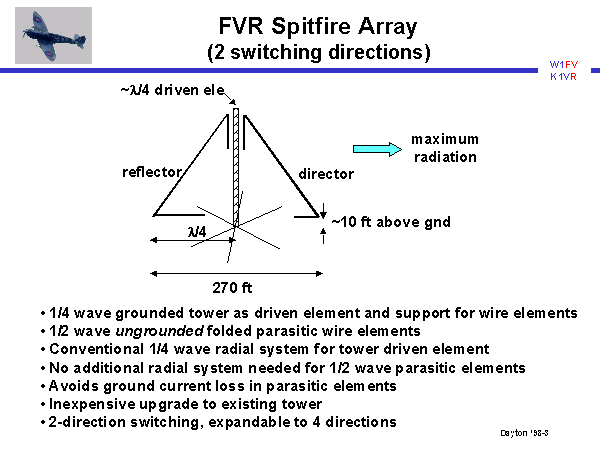
The Spitfire is a parasitic array which uses a conventional grounded quarter-wave tower
as the driven element and adds a parasitic reflector and director. What is unique about
this array is that the parasitic elements are sized to be half-wave elements which are not
grounded, unlike previous concepts where all the elements are grounded. As shown in the
figure, the elements are folded at their ends to meet the length requirements. The
advantage of ungrounded elements is that they do not use or need a ground radial system to
provide a current return path. This avoids a downfall of parasitic verticals with grounded
elements, which can be demonstrated in a computer modeling program. That is that the real
gain of grounded parasitic arrays quickly erodes when ground losses are present because
the losses prevent the proper current distributions from being induced in the parasitic
elements. The Spitfire does use a conventional quarter-wave radial system under the driven
element tower. The bottoms of the parasitic elements are about 10 feet above ground. This
distance is high enough for safety but low enough for doing necessary work. The only
critical dimension in the Spitfire array is the distance from the tower to the ends of the
parasitic elements. It was determined empirically through computer modeling that the
distance which maximizes F/B is exactly one quarter wavelength as shown in the figure.
(Gain is not particularly sensitive to that spacing). The configuration shown provides 2
switching directions (forward and rear). We will show how to turn it into a full 4
quadrant system.